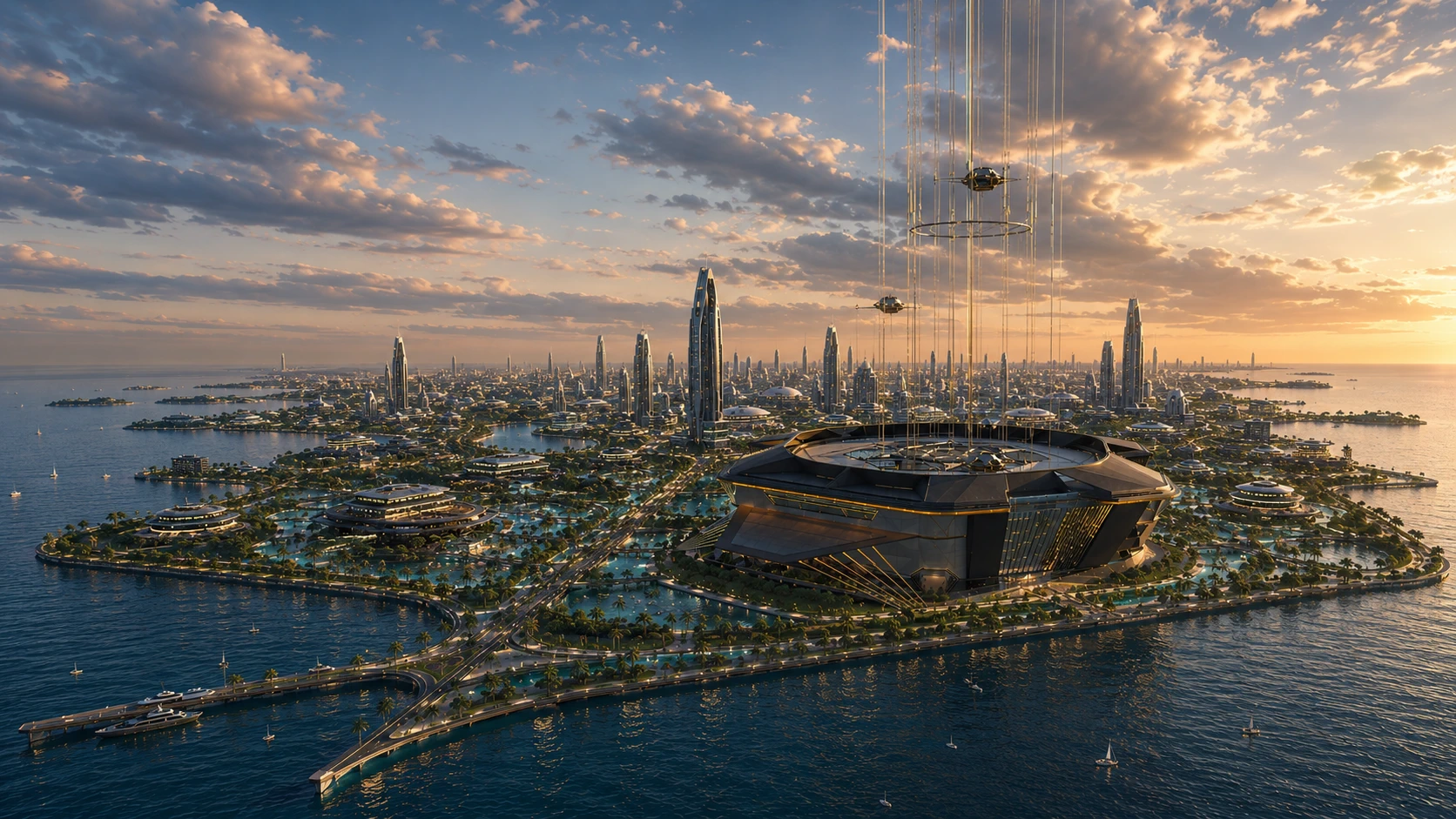
During the final age before humanity's great expansion into space, Earth faced an unprecedented crisis. Nuclear exchanges, resource wars, ecological collapse, and political fragmentation left much of the planet's population displaced. Entire regions became contaminated by fallout, while many of the world's largest cities fell into ruin.
In response, the surviving governments established the New Atlantis Initiative. The remote Saint Peter and Saint Paul Archipelago was selected for its isolated location along the Mid-Atlantic Ridge, far from the major conflict zones of the continents. Massive artificial landmasses were constructed around the islands, creating a self-sufficient metropolis capable of housing millions of refugees.
At the center of the city, engineers began work on what would become the Atlantic Space Elevator. Extending from the surface of Earth to a permanently inhabited orbital station, the structure dramatically reduced the cost of reaching orbit and transformed humanity's future.
The Atlantic Space Elevator is widely regarded as the single most important engineering project in human history. Without it, large-scale off-world migration would have been economically impossible.
Over the following centuries, billions of people departed Earth through New Atlantis. Initial settlement efforts focused on Luna and Mars before expanding throughout the Solar System. Colonies eventually spread to the Jovian moons, orbital habitats, asteroid settlements, and beyond.
The elevator later became the logistical foundation of the Destiny Mission, the interstellar colonization fleets that established humanity's first permanent settlements around Alpha Centauri, Delta Pavonis, and dozens of other nearby stars.